Pickleball and tennis are two sports that attract players of different ages and backgrounds. Both offer great fun, social interaction, and exercise, but they have distinct styles, equipment, and rules that shape how I play and enjoy each game. Having played both for years, I’ve noticed unique challenges in each, and my own preferences usually depend on my mood, energy, and who I’m playing with. In this article, I’m sharing a side-by-side look at pickleball vs tennis so you can figure out which one might fit your interests the best or how both can add something new to your regular activity lineup.
Overview and Origins
Pickleball was created in 1965 by a family looking for a backyard game, and it combines parts of tennis, badminton, and ping pong. The sport started on Bainbridge Island near Seattle, Washington, and grew through recreation centers before exploding in popularity in communities around North America. Today, pickleball is one of the fastest growing sports in the United States and much of Canada. If you’re curious about the details and fun facts, you’ll track down plenty of inspiring stories about how it spread from neighborhood games to national tournaments.
Tennis has a much longer history with roots in 12th century France, but the modern game took off in late 19th century England. Tennis is now an international sport played in public parks, schools, and on the professional circuit. Its traditions, championships (like Wimbledon or the US Open), and star players are recognized worldwide. Over the years, tennis has seen a glow-up in technology, styles of play, and audience size, making it a beloved sport for millions.
Equipment and Gear
Understanding the differences in the equipment for pickleball and tennis makes it easier for me to choose which one I want to play, and it shapes the style and feel of each sport.
- Pickleball Paddle: Pickleball uses a solid paddle, typically made from lightweight materials like graphite, composite, or wood. The paddle is short and does not have strings. Paddles usually measure about 8 inches wide and 15-16 inches long, making them easy to maneuver with less surface area than a tennis racket.
- Tennis Racket: Tennis rackets are larger and have a stringed surface. Rackets can be made from materials like graphite, carbon fiber, or a mix of composites, and they’re designed for hitting a heavier ball over longer distances. The larger head helps generate spin and power, giving players the ability to mix up their shots.
- Pickleball Ball: The ball in pickleball looks like a wiffleball. It’s made of hard plastic with holes throughout. There are indoor and outdoor versions, with outdoor balls having smaller, denser holes to resist wind and make games more consistent in breezy conditions.
- Tennis Ball: Tennis uses a pressurized rubber ball covered in felt. Tennis balls are heavier and bounce higher, making the game faster paced and more physically demanding in terms of chasing and positioning around the court.
Both sports require good, supportive court shoes to prevent injuries, but pickleball players can often wear general court shoes, while tennis players sometimes need more specialized shoes for different court surfaces such as clay, grass, or hardcourt. When getting started, it’s worth asking local store staff or fellow players for advice on shoe types, as proper footwear can make a big difference for comfort and safety.
Court Size and Setup
Court size can have a big impact on how the game feels. I notice this difference most when I’m switching between sports on the same day or even back to back. Here’s how court size compares for the two games:
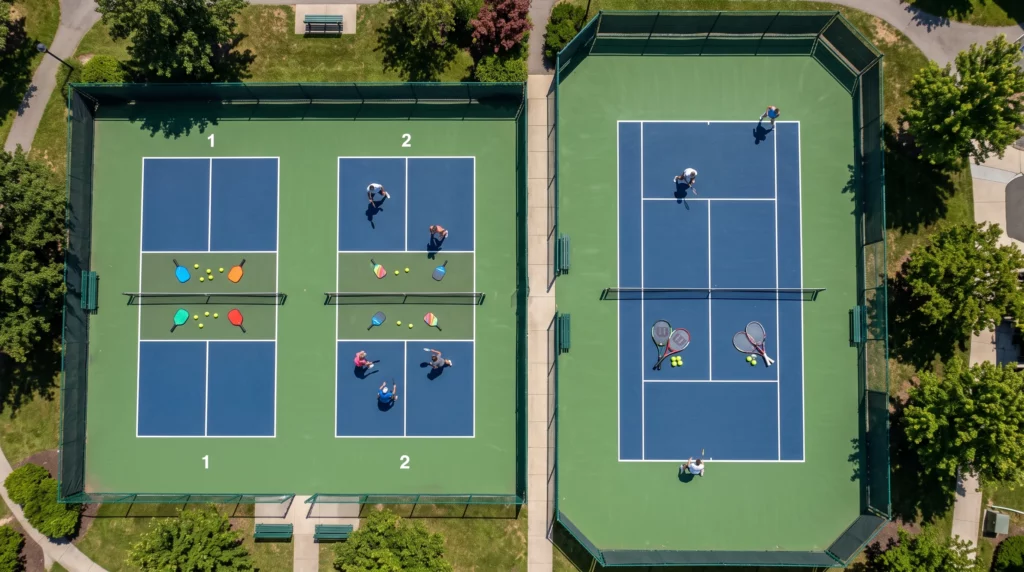
- Pickleball Court: Pickleball is played on a small court; it’s 20 feet wide and 44 feet long. The net is 36 inches high at the edges and 34 inches at the center. With a smaller space and less ground to cover, the rallies are fast, emphasizing reaction time and placement more than running speed. This makes pickleball accessible to a wider range of fitness levels and ages.
- Tennis Court: A tennis court is much larger; it’s 27 feet wide for singles and 36 feet for doubles, with a length of 78 feet. The net is 3.5 feet high at the posts and 3 feet in the center. Tennis requires more running, quicker transitions, and increased endurance, especially when playing singles. This extra space gives tennis its reputation as a sport that builds cardio and fitness fast.
Additionally, some tennis facilities now mark pickleball lines onto existing tennis courts to provide flexibility for both games, making it easy for communities to support multiple sports with minimal investment. If you’re interested in trying out both, you might stumble upon shared facilities in your area.
Rules of Play
The basic objective of both games is to win points by sending the ball over the net and into the opponent’s court in a way they can’t return. That said, each game has clear differences in how points are played and scored.
Pickleball
- Games are typically played to 11 points, and you need to win by at least 2 points.
- Points are only scored by the serving team, making server strategy important.
- Players serve underhanded from behind the baseline, aiming cross court.
- The “kitchen” (no volley zone) is a 7 foot area on each side of the net where players can’t volley (hit out of the air). This keeps the game honest and focuses play on touch and control near the net.
- After the serve, both sides must let the ball bounce once before volleys are allowed—a rule called the “double bounce rule.” This helps newcomers get used to the game before things speed up at the net.
Tennis
- Standard games are played to four points, using a scoring system (15, 30, 40, game).
- Points can be won by either player or team regardless of who is serving.
- Serves are overhand and alternate sides after each point.
- The only zones are inside or outside the playing area; players can volley or drop shot from anywhere on their side of the net, giving more freedom and room for creativity.
- Games, sets, and matches can last longer, increasing endurance and mental focus requirements. Tiebreakers and long rallies keep adrenaline up and test every part of a player’s game.
Physical Demands and Skills Required
Both pickleball and tennis build fitness, but they focus on different abilities. Here’s how each one challenges my body and skills:
Pickleball
- Quick footwork and fast reflexes, especially for volleys at the net.
- Emphasis on hand-eye coordination and soft touch—mastery of delicate placements is rewarded.
- Less running overall, which makes it easier on my knees and joints. Even with a gentle impact, pickleball still gets your heart rate up in a short time.
- Short, explosive movements are common, but extended rallies can get intense around the net as players try to outmaneuver each other with quick moves and softly placed shots.
Tennis
- Requires more running, stamina, and endurance, particularly in singles play where covering the whole court is necessary.
- More upper body and core strength needed to generate power and spin. Timing and rhythm are essential for consistent strong shots.
- Bounce timing and footwork are major factors, especially with the bigger court. Rallying successfully means combining speed with strategic movement.
- Long rallies put focus on game planning and mental toughness over extended periods. The best tennis players stay mentally locked in even as fatigue sets in late in matches.
Accessibility and Learning Curve
I often hear new players saying that pickleball feels more approachable, and in my experience, that’s generally true. Pickleball rules are easy to pick up, and the smaller court means rallies last longer, so beginners hit more balls and get the hang of things faster. The underhand serve is less intimidating, and the lighter paddle is easy to use for most people. Plus, in a typical community center or club, you’ll often find people excited to help you get started or let you watch before you jump in.
Tennis takes longer to master. There’s more to learn in serving, generating topspin, slice, and the physical intensity can be a barrier for those with less experience or mobility. Still, there’s nothing like the satisfaction of a well struck tennis ball or outlasting an opponent in a long rally—these moments make all the hard work worth it.
Cost to Start and Ongoing Expenses
One thing I appreciate about both sports is that you don’t need a big budget to get started, but there are a few cost differences:
- Pickleball: Beginner paddles are affordable, starting at around $30-$50. Outdoor pickleball balls usually cost less than $10 for a set. Many public parks have free or low-cost court access, especially in areas with active pickleball communities. Shoes can be regular court or athletic shoes, keeping initial costs low.
- Tennis: Entry level tennis rackets start at $30-$60. Tennis balls are about $3-$5 per can (with 3 balls per can), and more are needed due to the game’s pace and lost balls. Court fees vary; some public courts are free, others charge by the hour, and private clubs can get expensive. Tennis specific shoes may be required if you’re playing regularly or on certain surfaces.
Both sports have optional upgrades. For tennis, buying higher end rackets ($100+) or restringing regularly raises costs. In pickleball, composite paddles can range over $100, but most beginners stay happy with less expensive options until they’ve played for a while. As you level up, you may want to upgrade your gear, but there’s no need at the start.
Community and Social Dynamics
Pickleball is well known for its social atmosphere. I find open play sessions welcoming, players rotate in and out, and most people are happy to include new players. The sport’s reputation for friendliness and quick rallies makes regular play feel more like a group activity than a strict competition. It’s common to see games where people cheer on each other, share tips, and even head out for coffee after the match winds down.
Tennis also offers social play, but I’ve found that singles matches can be more individual focused. Doubles is great for teamwork and social enjoyment. Tennis leagues and club ladders build a sense of community, but larger courts and longer point setups mean you spend less time interacting during play than in pickleball. Still, post-match meetups, lessons, and club socials offer ways to make new friends through tennis too.
Injury Risk and Joint Impact
Both sports carry some risk of injury, but pickleball’s smaller court and less explosive movement usually mean less wear and tear on my knees, ankles, and shoulders. Sprained ankles or wrist issues can happen if I’m not careful, especially on concrete or older court surfaces. Tennis puts more pressure on joints because of all the running and heavy groundstrokes. Good footwear and awareness of my form help reduce injuries in either sport. If you have preexisting joint issues, pickleball is probably the better place to start, though proper stretching and rest are smart for all players.
Advanced Tips and Strategies
I picked up a lot of useful strategies through practice, and both sports reward consistency, control, and anticipation. In pickleball, mastering the “dink” shot (a soft shot that lands just over the net in the kitchen area) is a real game changer. Placement and quick reflexes at the net can create lots of winning points. Stack drills and practicing paddle position at the ready help improve control and response. I’ve also noticed that switching between hard and soft shots throws off opponents, so mixing things up is key.
In tennis, learning to mix up shots is really important. I work on my serve consistency, volleys, and learning how to spot an opponent’s weaknesses. Conditioning and mental focus help me in longer matches. Trying out different grips and experimenting with spin add new tools to my game, making each match more interesting and giving me more chances to win points. Whether you like baseline rallies or charging the net, there’s always something new to learn and practice.
For both sports, watching experienced players—either in person or on videos—can give real insight into tactics, movement, and mental focus. Practice often, play with better players when possible, and don’t be afraid to ask questions; the communities for both tennis and pickleball are usually eager to help you grow.
Who Should Try Each Sport?
- Pickleball is a great fit for: Anyone who wants a social, easy to learn sport. It’s especially popular with older adults or those new to racquet sports, but it now attracts people of all ages, including teens and kids. Pickleball is gentle on joints and offers fast paced rallies without a huge time commitment. If you’re looking for a low-cost, inclusive activity, pickleball is worth a try.
- Tennis is a better match for: Players who enjoy a tough workout, love tradition, or want a sport with more variety in game planning and power. Tennis is suitable for a wider range of physical challenges, though it does require more time to develop basic skills. If you love the idea of long matches, classic rivalries, and a deep skillset, tennis is for you.
Frequently Asked Questions
What are the biggest differences between pickleball and tennis?
Pickleball uses a smaller paddle and plastic ball on a small court, making for shorter running distances and longer rallies. Tennis uses a stringed racket and pressurized ball on a big court, requiring more running and upper-body strength. Each game rewards a different set of skills and fitness levels.
Can you play pickleball on a tennis court?
Most tennis courts can be used for pickleball with portable nets and temporary lines. Some parks have both side by side. Check with local recreation centers or city guidelines before taping lines. Adding pickleball lines is a popular way for parks to serve more players.
Is pickleball easier on the joints compared to tennis?
Yes. Because of the small court and lighter paddle, pickleball typically has less impact on knees, hips, and shoulders. Always wear supportive shoes and stretch before playing to tone down injury risk in either sport. If you want to ease back into sports after a break, pickleball is a forgiving entry point.
How long do games last?
Pickleball games are usually quick (15-30 minutes). Tennis matches can last longer, sometimes over an hour, especially in tournaments or competitive league play. The length makes pickleball easy to fit into a busy schedule, while tennis offers a more substantial physical challenge.
Final Thoughts
Both pickleball and tennis offer great ways to stay active, connect with others, and develop new skills. Each has its own unique appeal, and I often recommend trying both if you’re deciding which to pursue more seriously. Switching between the two keeps my interest high, strengthens different parts of my game, and opens up more ways to meet people and have fun. Whether you’re looking for a friendly social match or a challenging test of endurance and skill, both sports have plenty to offer, and it’s worth giving each a shot to see what fits best for you. Whichever you choose, get involved, enjoy the ride, and have fun on the court!