If you already know you can’t hit a volley from the kitchen, the calls against you can still feel arbitrary. Most pickleball kitchen rule faults come from the edges of that rule: a toe on the line, a step forward after a volley, a hat that falls off. Players who understand the basic idea still lose points to these, usually at the moments when they are most committed to a shot.
This article goes through the faults that actually come up in games, explains why each one is called, and gives one habit or piece of gear thinking to prevent it.
The one rule behind every kitchen fault: no volleying while you’re in the zone
The kitchen is the non-volley zone, the strip of court that runs 7 feet back from the net on each side. A volley is any shot you hit out of the air before the ball bounces. The rule joins the two: you may not hit a volley while you are touching the kitchen.
Every fault in this article is a variation of that sentence. Either you volleyed while touching the zone, or you touched the zone as a direct result of volleying. The ball does not have to be in the kitchen for the fault to count. Only your position matters.
You are free to stand in the kitchen at any time when you are not volleying. Standing there while the ball is on the other side of the court is fine. The fault only exists in combination with a volley.
The line is the kitchen: why a toe on the stripe is a fault
The line that marks the back edge of the kitchen belongs to the kitchen. A foot on that line is a foot in the zone, so a volley with your toe on the stripe is a fault.
This catches a lot of players because the line feels like a boundary you can stand on, the way a baseline works in tennis. In pickleball the stripe is part of the restricted area. Beginners tend to creep forward to get closer to the net, stop when they see the line, and leave their front foot right on top of it.
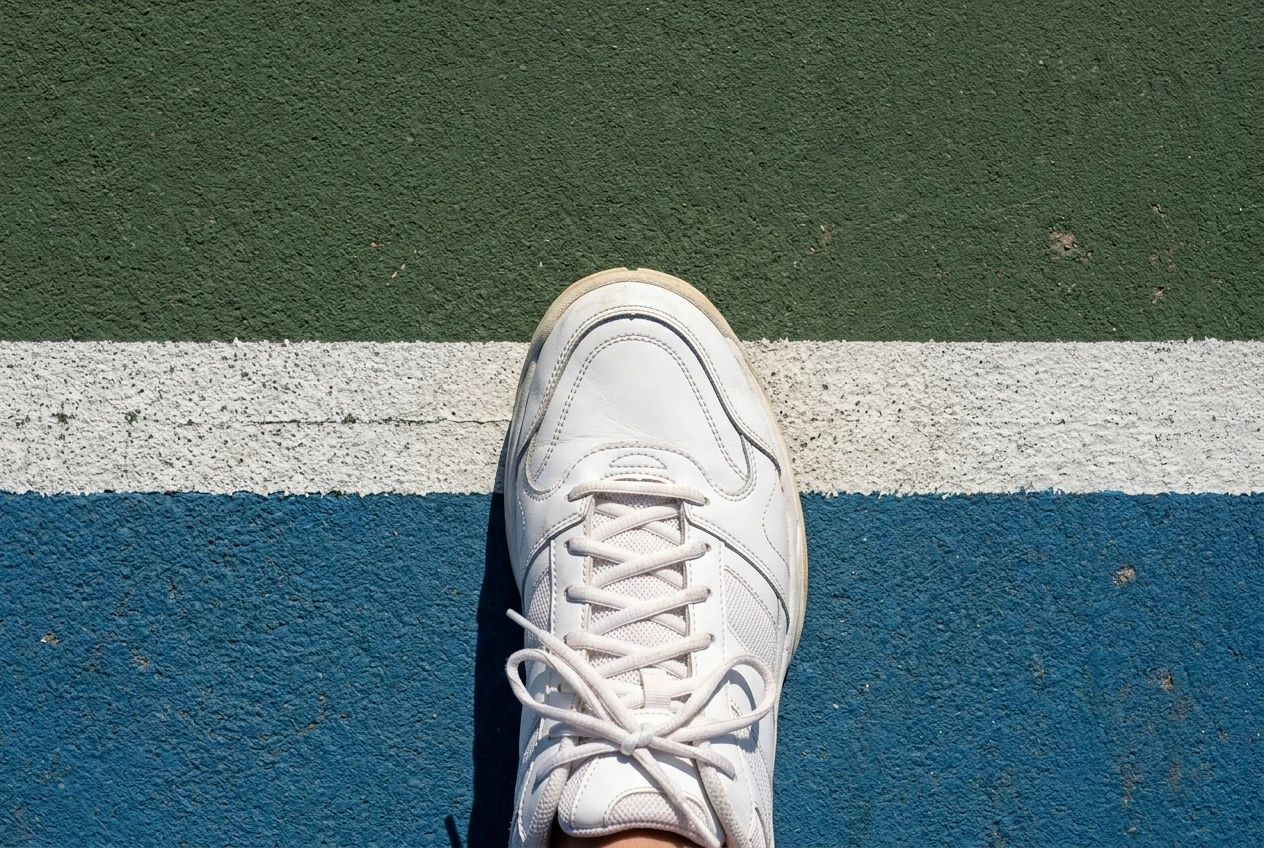
The fix is a visual habit. Before the ball comes back, look at your front foot, not the ball. Your toe should be clearly behind the stripe, with a small gap of paint-width or more showing between the front of your shoe and the line. Many players find it helps to set up a few inches back from where feels natural, since a ready position behind the line gives you room to step forward after a bounce and still react to a quick volley.
A second habit: when a dink is coming and you think you may have to volley, glance down once as the opponent makes contact. If you are on the line, adjust your feet before the ball arrives, not after.
Momentum faults: when your body carries you in after the volley
Momentum is the fault players dispute most, because the volley itself was legal. You were behind the line, you hit the ball cleanly, and then your body drifted forward and a foot landed in the kitchen. That is still a fault. The rule covers your position after the volley as well as at the moment of contact, and it applies even if the ball is already dead or your opponent has not yet returned it.
The same logic applies to jumps. If you leave the ground outside the kitchen, volley in the air, and land inside it or on the line, that is a fault too.
These happen most often in three situations:
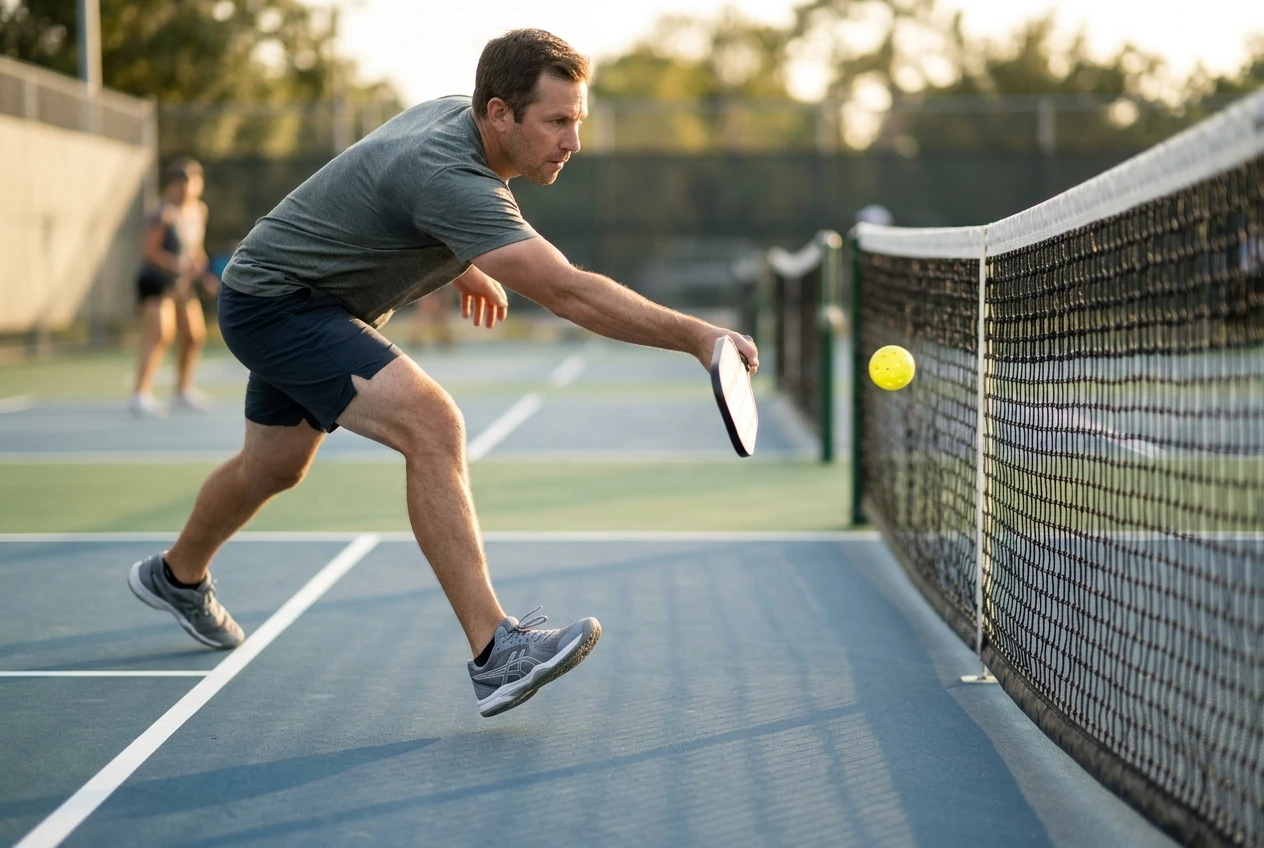
- A hard volley at the net. Swinging through the ball transfers weight forward, and the front foot follows.
- A reach volley. A wide or low ball pulls you off balance, and you step to recover in the wrong direction.
- A fast exchange. You are moving forward with the rally and do not have time to reset.
The footwork fix has two parts. First, shorten the swing. Most volleys at the net are punches or blocks with little follow through, and a short motion leaves you less forward energy to absorb. Second, finish each volley by stepping backward or sideways, not forward. Taking a small step back after contact becomes automatic with practice and keeps your feet on your own side of the line.
Think of the volley and the recovery step as one movement. If you only plan the hit, the recovery will be improvised, and improvised steps tend to go forward.
What else counts: paddle, clothing, hat and anything you’re wearing or carrying
The fault is not limited to your feet. Touching the kitchen with any part of your body counts, and so does touching it with anything you are wearing or carrying. That includes:
- Your paddle, if it touches the kitchen surface as you volley or while you follow through.
- A hat, visor or sunglasses that fall into the zone during or just after a volley.
- A towel, water bottle or ball in your pocket or hand that touches the zone.
Your paddle can be over the kitchen when you volley, as long as it does not touch the ground or line in the zone. Reaching over the kitchen with your paddle is legal. Your body weight, though, still has to stay outside the zone.
Paddle touches usually happen on low volleys. You bend down to scoop a ball near the net and the paddle tip scrapes the court on the way through. The habit that helps is bending your knees to get low, instead of dropping the paddle head toward the floor. Your paddle hand should stay up and in front of your body.
Hats and visors cause more faults than players expect, mostly in windy conditions or during a lunge. If you wear one, check that it is snug before you play, because a hat that tips off during a stretch can land in the zone while you are still in the volley motion. Pockets deserve the same check. A ball that falls out of a pocket while you reach is rare but a real fault when it happens.
One clarification that settles many arguments: the fault applies to the player who volleys. Your partner standing in the kitchen at the time does not cause a fault for you, as long as you are not touching it yourself and your partner is not the one volleying.
When you’re allowed in: stepping into the kitchen legally after a bounce
Nothing stops you from entering the kitchen. You just cannot volley while there. If the ball bounces in the kitchen, you may step in and hit it. If a ball lands short, stepping in to play it is normal, and it is one of the most useful skills at the net.
The sequence to learn is simple:
- The ball bounces in or near the kitchen.
- You step in and hit it after the bounce.
- You leave the kitchen before the next ball comes if it could be a volley.
The third step is the one that is easy to forget. After you hit a dink from inside the zone, you must be fully out of it before you volley the next ball. Being partway out is not enough. A heel on the line is still in the zone.
A useful habit is to get out of the kitchen right after the shot, before you start tracking where the ball is going. Players who linger because they are watching the reply often turn a legal bounce hit into a fault on the very next shot.
Footwork and gear habits that keep you out of trouble, from shoe grip to paddle reach
Footwork gets most of the attention, but equipment affects how well you can stop at the line.
Shoe grip. Stopping quickly requires traction. Court shoes with a grippy outsole let you plant and decelerate right behind the line. Shoes with worn soles, or running shoes built for forward motion, tend to slide on a smooth court surface, and a slide of even a few inches can put you across the stripe. If you find yourself skidding forward on the last step to the net, check the tread on your outsoles before you blame your technique. Court and surface also matter: a dusty or damp court needs more care no matter what you wear.
Paddle reach. Your paddle’s length determines how far you can hit from behind the line without stepping forward. A paddle that feels short at the net can tempt you to lean or step toward balls that are just out of range. A longer paddle adds reach, though it usually changes balance and swing feel, so it is worth trying before you commit. A shorter paddle can feel quicker for blocks, but you will need to be more disciplined about staying back. If you often reach for a ball and drift in, the cause may be that the paddle you use does not match your net game. Our look at pickleball paddle technology explains how construction affects feel.
Grip. A paddle that rotates or slips in a sweaty hand makes you adjust your position mid-point. A secure grip lets you keep your stance and swing short, which feeds back into fewer momentum faults.
Clothing and accessories. Wear a hat that stays on and keep pockets zipped or empty. Nothing you carry should be able to fall into the zone.
Gear never replaces footwork. It reduces the number of things that can push you over the line, so your habits are the only variable left.
Drills to practice staying out, plus how to check your home court lines against the layout in our court dimensions guide
Faults come from habits, and habits change through repetition at low speed. These drills train the specific movements above.
- Line-awareness volleys. Stand a clear foot behind the kitchen line while a partner feeds slow balls at your body. Volley each one, then immediately step back with the trailing foot. Do twenty reps, then check where your front foot ended up after each one.
- Stop and hold. Start at the baseline, walk or jog to the kitchen line, and stop with both feet behind it. Hold for two seconds. Repeat ten times. This builds the stopping control that shoe grip supports, and it shows how much room you need before the line.
- Dink and retreat. Dink with a partner. Whenever a ball bounces in the kitchen, step in and hit it, then step out before the next shot. Call out “out” each time you leave, so the exit becomes automatic.
- Paddle-low check. Have a partner feed low volleys. Practice bending your knees to reach the ball while keeping the paddle head above the court. A coin or small marker placed on the line is a useful visual reference.
- Reach test. Stand just behind the line and reach with your paddle toward balls fed to the side. Note the farthest ball you can hit without stepping forward. That is your real net reach, and you can play the rest with a bounce or a retreat.
Before any drill, make sure the court itself is correct. If you play on a driveway, a converted tennis court or a taped-down space, the kitchen may not be 7 feet from the net, and you will be practicing against the wrong boundary. Measure from the net to the kitchen line on both sides and compare it with the layout in our pickleball court dimensions guide. The kitchen is 20 feet wide across the court. A line a few inches off will teach your feet the wrong distance, and those habits follow you to every other court you play on.