If you are working out how to choose a pickleball bag, start with your gear, not the bag. Most bags that get replaced after a month were bought on looks or a brand name, and then turned out to be too small for the shoes or too big for a single paddle. Counting what you carry first takes about ten minutes and makes the rest of the decision much easier.
Start by laying out everything you carry to the court
Put everything you take to a session on a bed or the floor. Include the things you usually leave in the car, because some days they come with you. Then sort the pile into three groups.
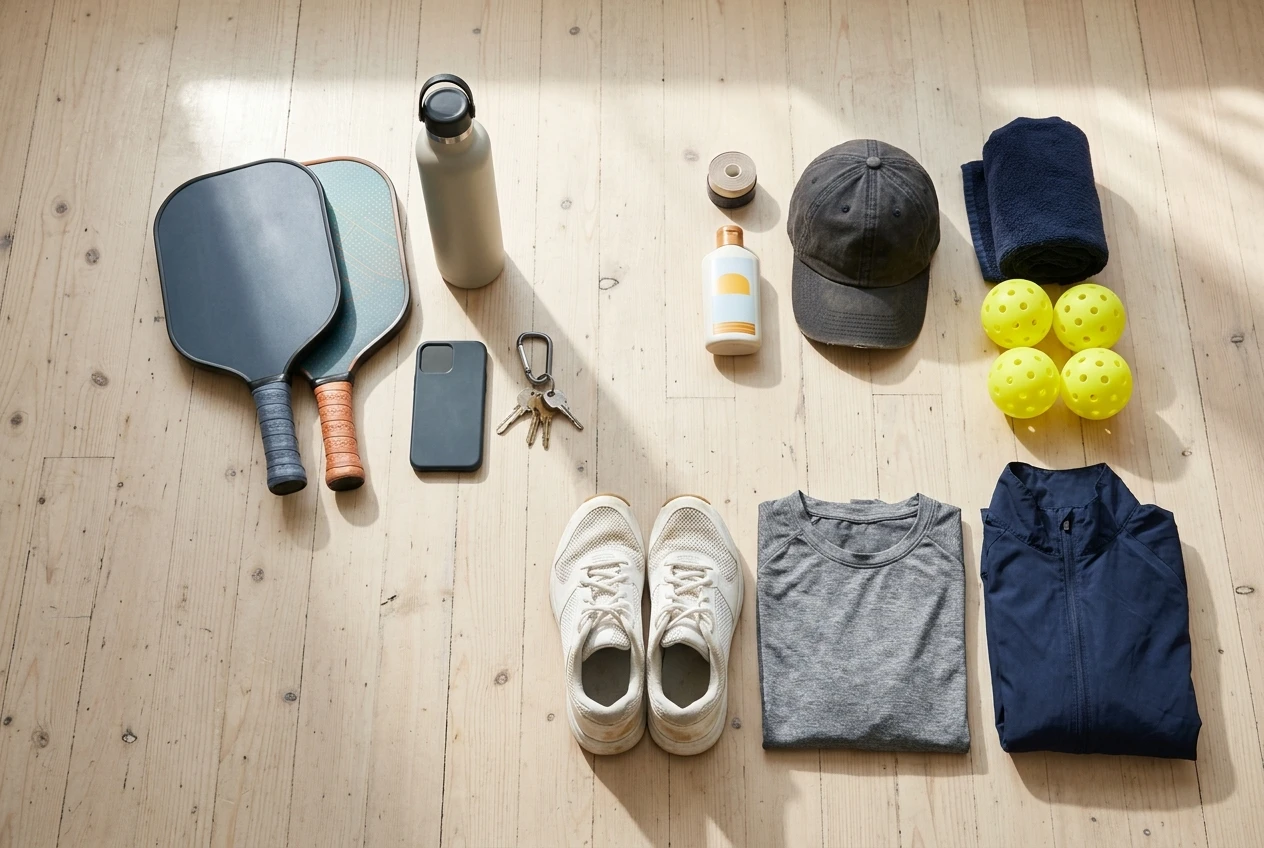
- Always: paddle or paddles, a water bottle, your phone and keys.
- Most days: a spare grip or overgrip, sunscreen, a hat, a towel, a few balls.
- Sometimes: court shoes (if you change at the court), a spare shirt, a jacket, a first-aid item, a second water bottle, snacks.
The bag has to hold the first two groups comfortably. The third group decides whether you need extra room or whether a separate pouch or a hand-carried item will do. Carrying something occasionally is not a good reason to buy a bag that is half empty most of the time.
Check the length of your longest item too. A paddle is the one thing that cannot be folded or squashed, so any bag you consider needs a compartment or sleeve long enough to take it without bending the bag around it.
The one-paddle player: when a sleeve or small sling is enough
If your always group is one paddle, a water bottle and your keys, you do not need a backpack. A padded sleeve or a small sling bag covers it, and either one weighs almost nothing when you walk from the car or the bus stop.
A paddle sleeve protects the face and edge guard from scrapes and holds nothing else. It suits players who keep a water bottle in a cup holder, store balls in a pocket, or play at a facility close to home.
A small sling adds a pocket or two for keys, a phone and a couple of balls. Look for a sling with a strap you can adjust, so it sits against your back while you play, and a paddle compartment that closes fully rather than leaving the handle exposed.
This setup has one weakness: it has no room for growth. If you add a second paddle, a pair of shoes or a towel, you will find yourself carrying things in your hands. That is a sign you have moved into the next category, not that the sling was a bad purchase.
The regular with two paddles: backpacks and slim tote bags
Many regular players carry two paddles. One may be a backup in case the first cracks or its grip wears out. Another may be a different type for different partners or conditions. Add a water bottle, a few balls, an overgrip and a towel, and you are past what a sleeve can handle.
Two bag types fit this load.
Backpacks
A compact backpack spreads weight across both shoulders, which matters if you walk or cycle to the courts. Look for one with a dedicated paddle pocket along the side or back panel, plus a main compartment for a towel and a change of socks. A backpack also leaves your hands free for a coffee or a court gate.
Slim tote or racket-style bags
A slim tote or a narrow racket-style bag keeps the paddles flat and separated, and it is quick to open. These are comfortable if you drive and carry the bag only from the car to the court. The trade-off is that most carry on one shoulder or by hand, which gets tiresome over longer walks.
Whichever you choose, check that the two paddles can sit in separate spots or sleeves. Paddles stored face to face can scuff each other, and a loose handle can dent the face of the one beside it.
The full-kit player: shoes, balls, water and spare clothes
If you play in leagues or tournaments, or spend a long morning at the courts, your pile probably includes court shoes, a full set of balls, a larger water supply, a change of clothes and perhaps a towel and a jacket. This calls for a larger backpack or a duffel-style bag with several compartments.
Here is what to look for, in order of importance.
- A separate shoe compartment. Shoes carry dirt and moisture. A ventilated or lined compartment keeps them away from clean clothes and paddles.
- A paddle section that is padded and separate from the main space. If you pack a bag full, the paddles must not be crushed by it.
- A side pocket for a water bottle that you can reach without unpacking.
- A separate pocket for valuables so your phone and keys are not at the bottom under a damp towel.
Bigger bags tempt people to carry more than they need, and a full bag gets heavy fast. Weigh it before you commit to carrying it up stairs or across a large parking lot. If you eat or drink between matches, the guide on pickleball nutrition tips for athletes can help you decide what actually needs to go in the bag.
Features that matter more than the brand name
Brand names tell you little about how a bag will work for you. The features below tell you much more, and you can check each one in a store or from a product listing’s photos and description.
- Paddle fit. Confirm the pocket or sleeve is long and wide enough for your paddle, including the handle. Paddle shapes vary, so measure yours.
- Padding where it counts. A thin fabric sleeve guards against scratches but does little against a knock. If you toss your bag into a trunk or a locker, look for padded walls around the paddle area.
- Zippers and straps. Strong zippers and well-stitched strap anchors fail less often than decorative details. Open and close each zipper a few times before you buy, if you can.
- Ventilation. Mesh panels or small vents in a shoe or wet-gear section let moisture escape.
- Carry style. Shoulder strap, backpack straps and top handle all feel different once the bag is loaded. Choose according to how you travel to the court, not how the bag looks empty.
- Water resistance. A coated fabric helps in light rain and keeps spills inside the bag from leaking out.
If two bags have these features equally, then price, color and brand are fair tiebreakers. They should not come first.
Protecting your paddle from heat, knocks and wet gear
A bag is partly a storage tool, and paddles are the most expensive thing in it. Three problems cause most of the damage.
Heat. Paddles are built from layers of materials bonded together, and high temperatures are hard on that construction. A closed car on a warm day gets far hotter than the air outside. Keep the bag in the shade, in the cabin, or indoors, and check the care notes that came with your paddle. An insulated or thermal paddle pocket gives some extra protection if you cannot avoid warm conditions.
Knocks. Edge guards and faces take scrapes and dents when a loose paddle shifts against keys, bottles or another paddle. Keep paddles in their own padded pocket or sleeve, and do not stack heavy items on top of them.
Wet gear. Damp towels, sweaty shirts and used shoes release moisture inside a closed bag. Put wet items in a separate compartment or a washable pouch, and air the bag out after each session. A sweaty grip can also feel slick the next time you play, and the guide on custom grip tape for sweat absorption in humid climates covers that side of the problem.
At home, take the paddles out of the bag between sessions rather than leaving them zipped in for days. That lets the bag dry and stops a musty smell from building up.
Match your bag to your gear in three quick questions
Go back to your sorted pile and answer these.
1. How many paddles do you carry? One points to a sleeve or small sling. Two points to a compact backpack or slim tote. Three or more, or a mix of paddles for different conditions, points to a larger backpack or a racket-style bag with separate compartments.
2. Do you carry anything besides the paddle, water and keys on most days? If the answer is no, stay with the smallest bag that holds your paddle. If you carry a towel, an overgrip and balls, move up to a backpack or tote. If you carry shoes and spare clothes, choose a bag with a separate shoe compartment.
3. How do you get to the court? Walking or cycling favors backpack straps and a lighter load. Driving gives you more freedom to carry a larger bag by hand, but a backpack still helps in a long parking lot or at a tournament venue with several courts.
If your answers point to different bag types, choose the one that fits your most days load, and cover the occasional extras with a small pouch or a tote kept in the car. That way you buy one bag that suits how you actually play.
Your paddle and your bag work as a pair, since the size and shape of one affects the fit of the other. If you have not chosen a paddle yet, read our guide to the best pickleball paddles for spin shots, or the one on lightweight pickleball paddles for seniors. Pick the paddle first, check its measurements, then use the questions above to find a bag that holds it and everything else you bring.